OrcaHello
When Orcas call, we’re listening
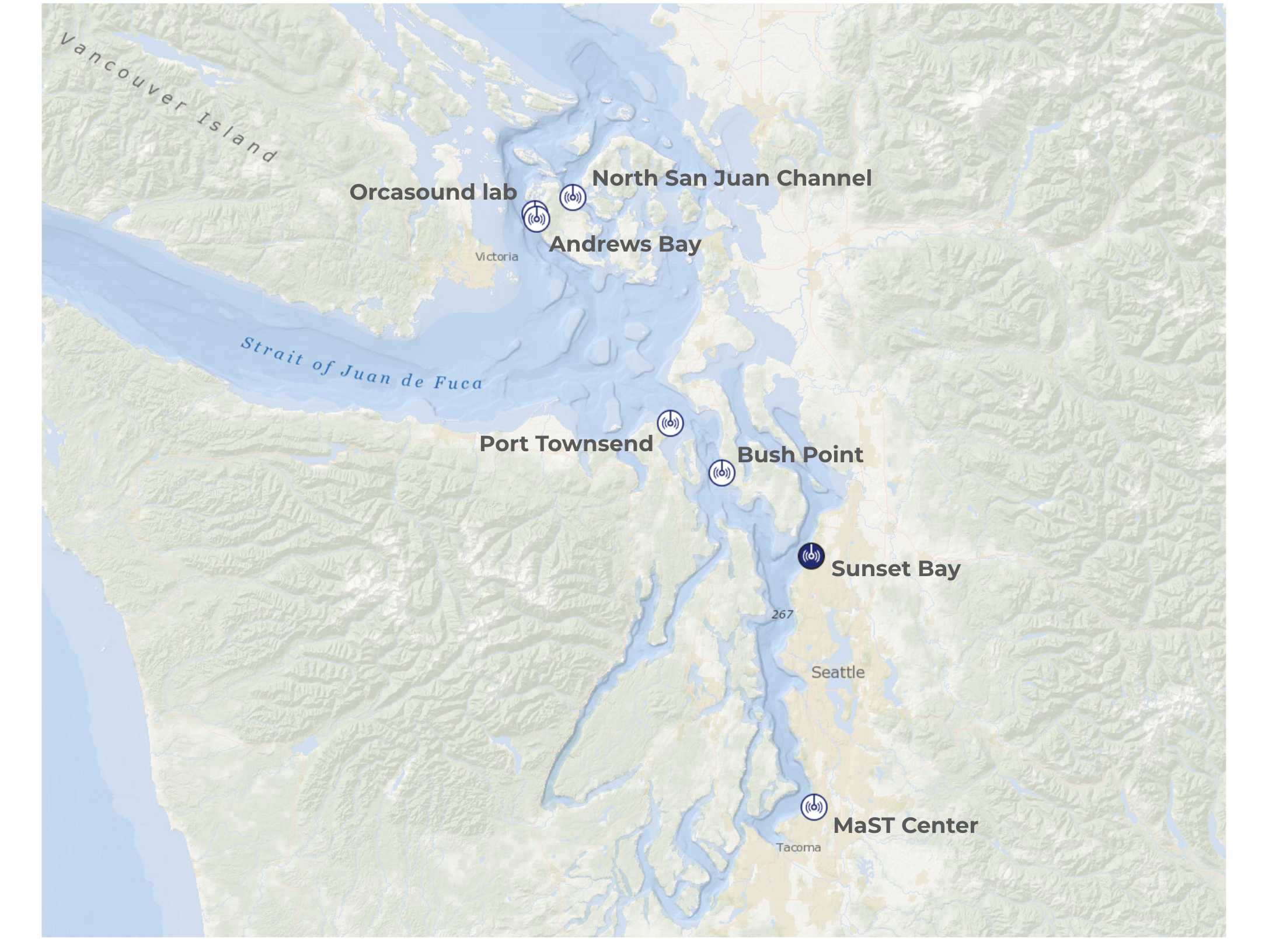
OrcaHello is an open-source AI-powered acoustic monitoring system that makes round-the-clock listening for endangered Southern Resident Killer Whales practical for the first time across 7 locations in the Puget Sound.
The whales rely on vocal pulsed calls, whistles and echolocation clicks to communicate and hunt their preferred prey, Chinook salmon. Their population continues to face the threat of decline due to lack of prey availability, contaminants, noise interference with echolocation when hunting, and vessel strikes.
24×7 Bioacoustic Monitoring
While Washington has various visual orca monitoring systems in place, bioacoustic monitoring of underwater sounds does not have the logistical constraints and inconsistencies associated with crowdsourced human observations. Hydrophones provide a non-invasive way to monitor whale presence that is effective 24/7 – at night, in low-visibility and in inclement weather. AI ensures that all activity is monitored, round-the-clock.


How it works
The system continuously analyzes live audio streams from hydrophones on the Orcasound network, using AI to find the “needle in the haystack” – filtering hours of ocean sounds down to candidates for review (on average <10 min/day). Behind the scenes, marine mammal experts confirm whale presence, identify pod and call type when possible, and make go/no-go decisions about sending alerts. Only after this expert review are notifications sent to subscribers, ensuring alerts are both timely and reliable.
Real-world impact
When moderators confirm a whale visit, alerts go out to conservation partners who can take action: Washington State Ferries, the Port of Seattle, and the Quiet Sound program coordinate vessel slow-downs and pause pile-driving during whale presence.
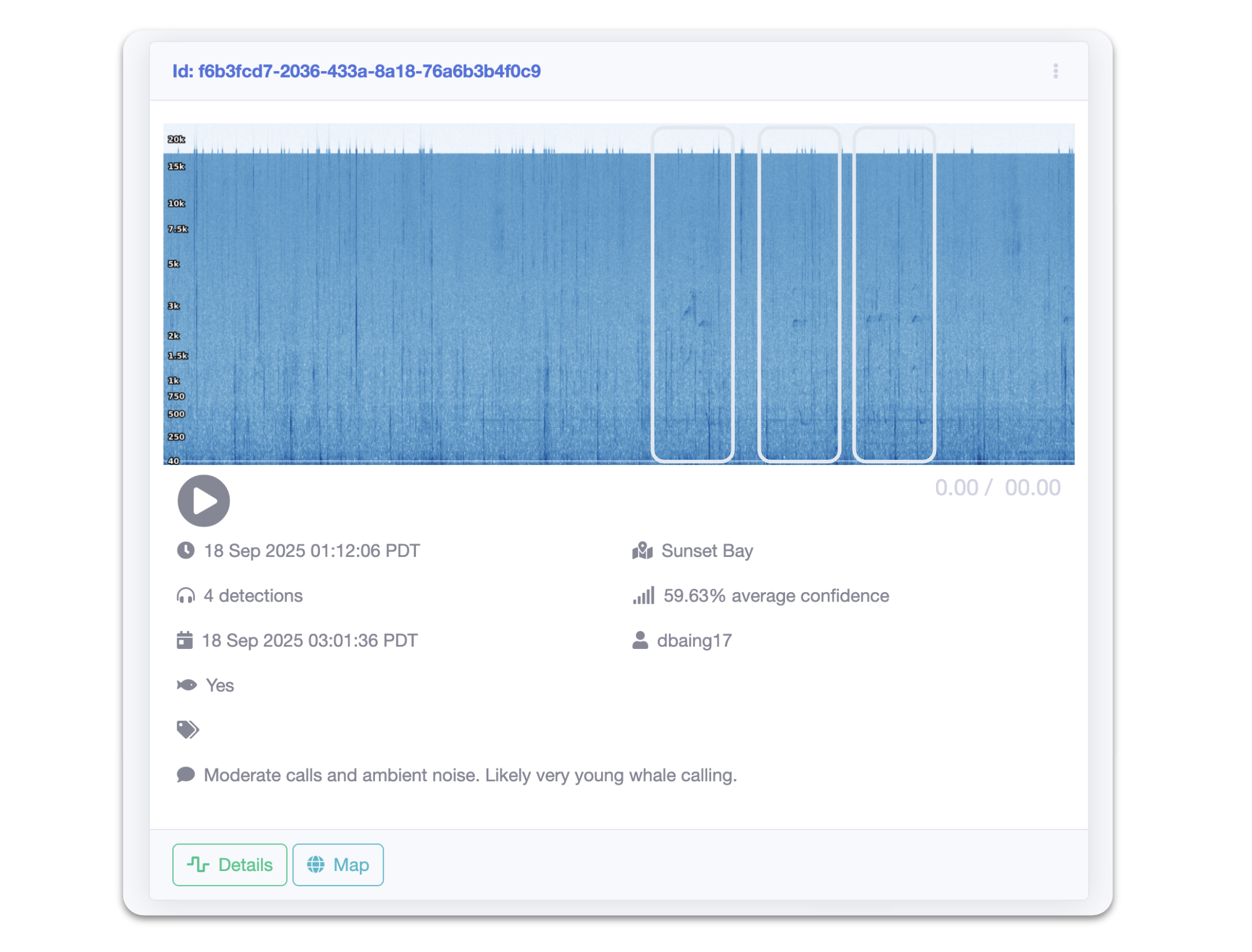
In September 2025, OrcaHello captured the first recorded calls of a newborn J-pod calf at 1AM Pacific – before visual sightings the next day (Maple Ridge News). This moment highlighted how 24-hour acoustic monitoring can detect critical events that occur beyond the reach of daytime visual monitoring systems.
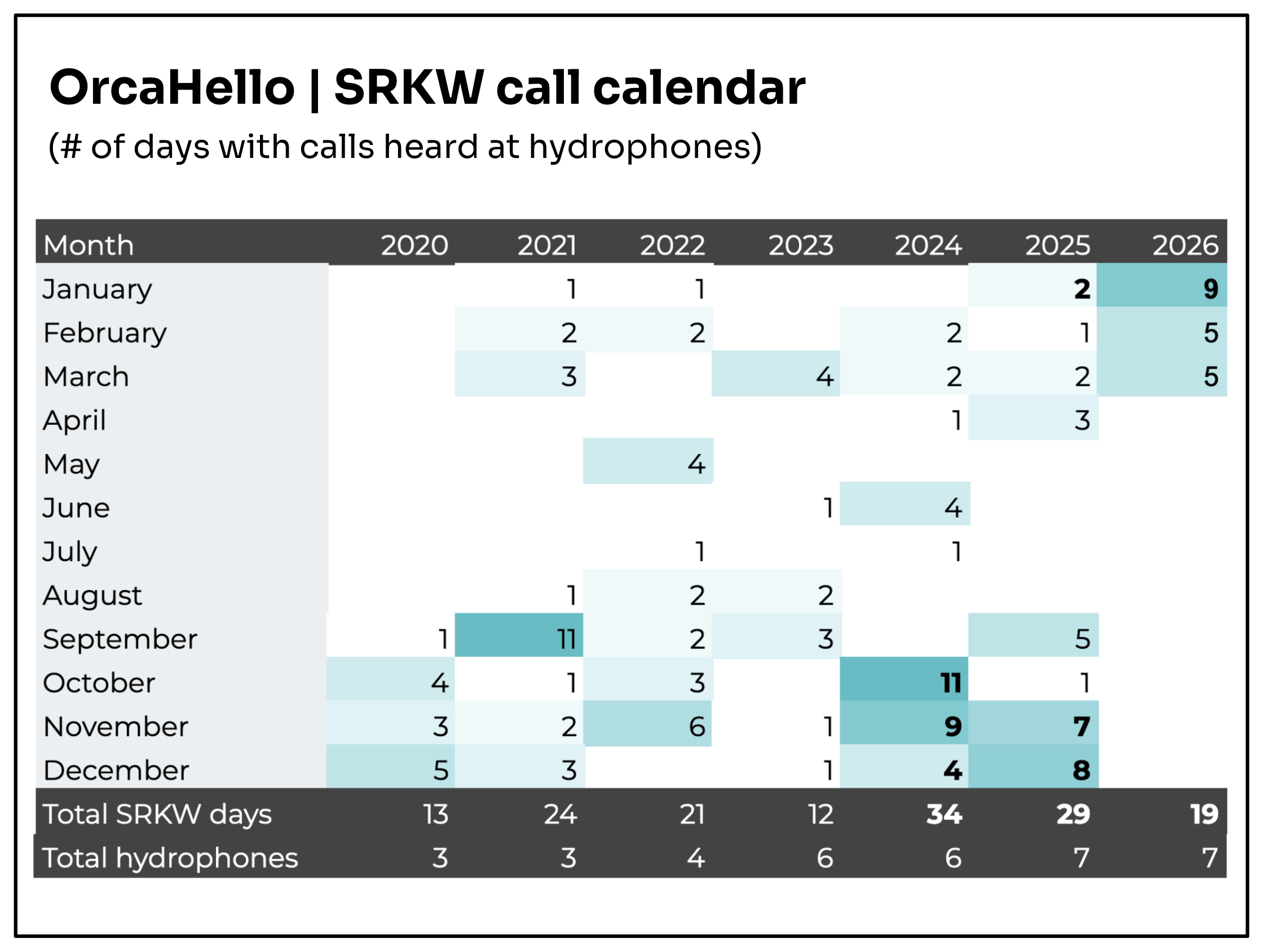
Since launching in September 2020, OrcaHello has picked up confirmed SRKW calls on over 150 days, with detection increasing in winter months when Southern Residents are most active in the Puget Sound. The underlying Orcasound hydrophone network being monitored also grew from 3 to 7 locations over this time.
A growing dataset for research
During development, the team developed Pod.Cast, a web-based annotation platform that has generated approximately 15 hours of fine-grained annotated whale call data. This data was incorporated into a landmark bioacoustic dataset for orca research (Palmer et al. 2025, Nature), which has been used to evaluate foundation models like Google DeepMind’s Perch 2.0 (Burns et al, 2025).
OrcaHello expert moderations also continue to produce a unique “in-the-wild” dataset of 6,700+ minutes of moderated hydrophone recordings – including 1000+ minutes of confirmed orca calls alongside challenging anthropogenic sounds and other marine life (as of March 2026). You can take a listen to a curated list below.
Greatest Hits Recordings
Links to a curated selection of moderated OrcaHello recordings.
| Orcas (SRKW) | |
| Jpod newborn first calls | Picked up at 1AM on Sep 18 2025, before visual sightings the next day. Written about in Maple Ridge News |
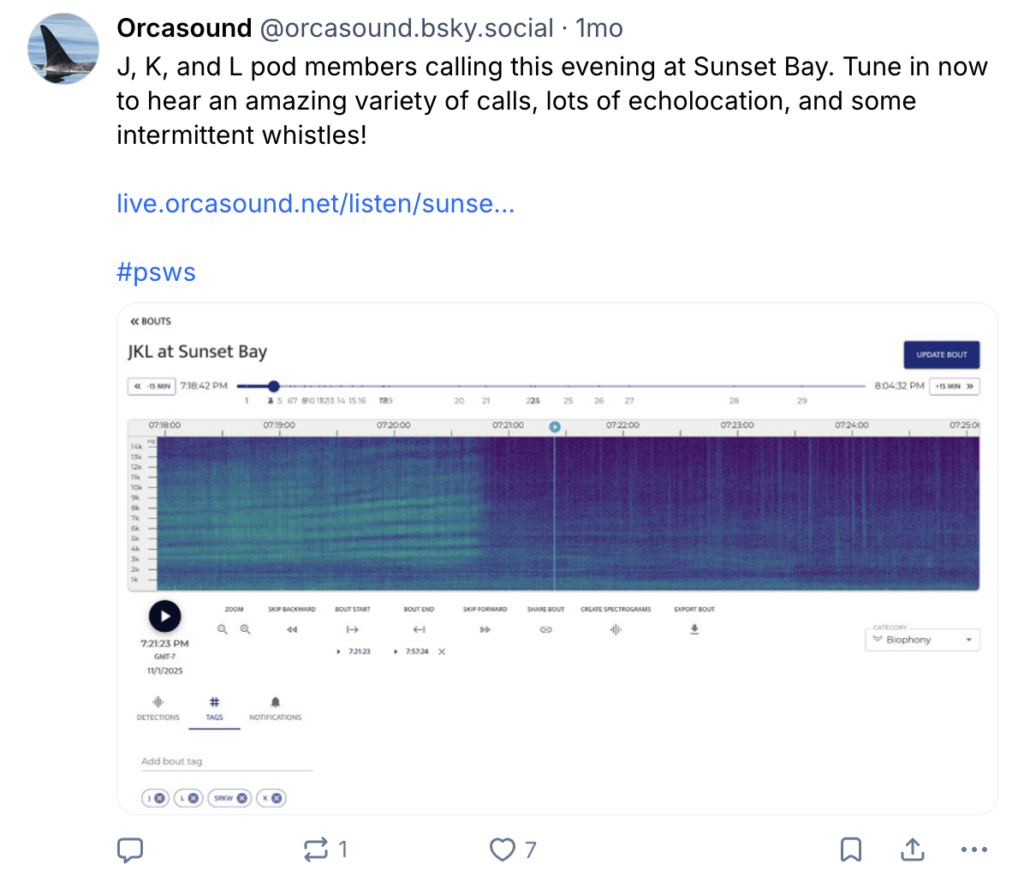
| JKL pod Nov 2025 | Eventful ~1hr “bout” with calls, vessel noise, human and machine detections on the Orcasound web-app |
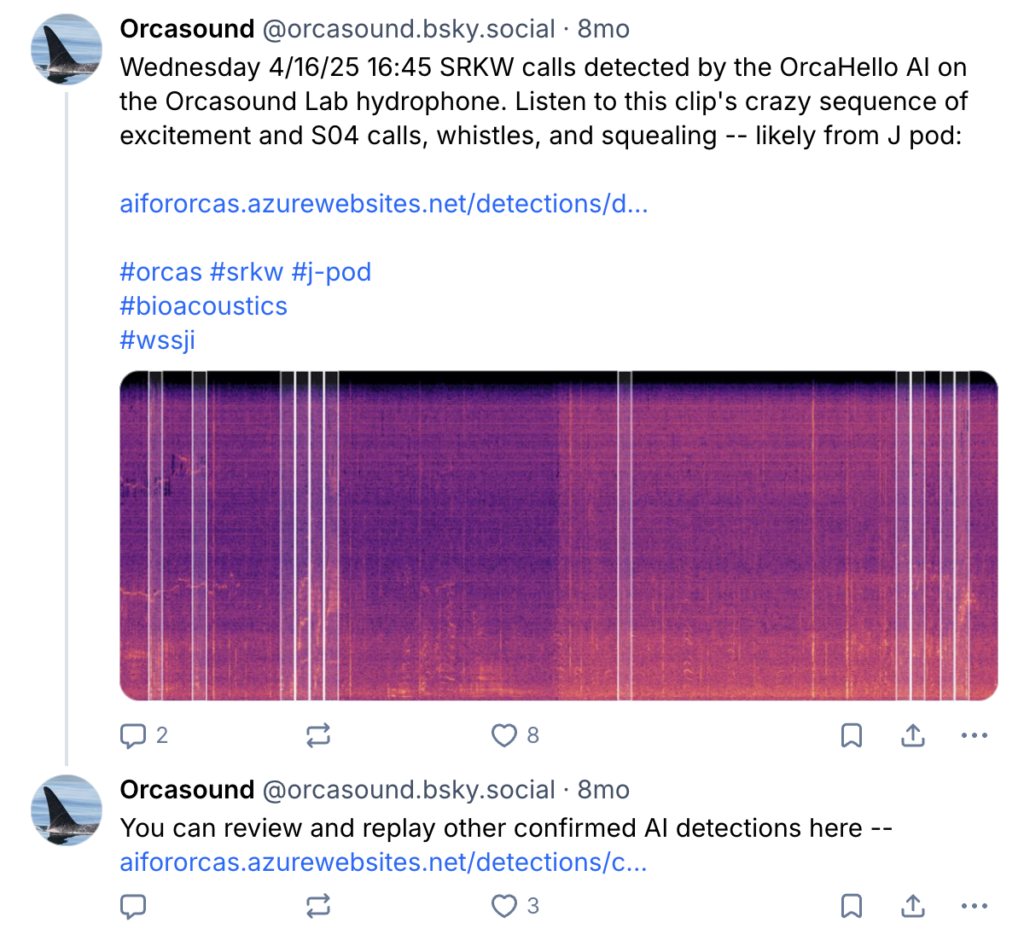
| Jpod-2020, Jpod-2021, Jpod-2025 | Mix of high quality pod-specific calls over the years |
| Marine life | |
| River Otter | Splashing & squeaks. One of the first false positives after deployment in Sep 2020. |
| Bigg’s transient killer whale | Not to be confused with SRKW, sounds similar to a layperson |
| Humpback whale | Beautiful calls, lots of reverb |
| Seagulls, Pigeon Guillemot | Bird calls are also occasionally audible at low tide |
| Anthropogenic sounds | |
| Vessel noise (low intensity) | Container ship & some undersea chains |
| Boat, Mechanical winch | Can be confused for biological sounds |
| Ship drive shaft | Repetitive squeak from a ship’s drive shaft |
| Port Townsend bell bouy | Clangs possible activated by intermittent ship wakes passing |
From hackathon to global open-source effort
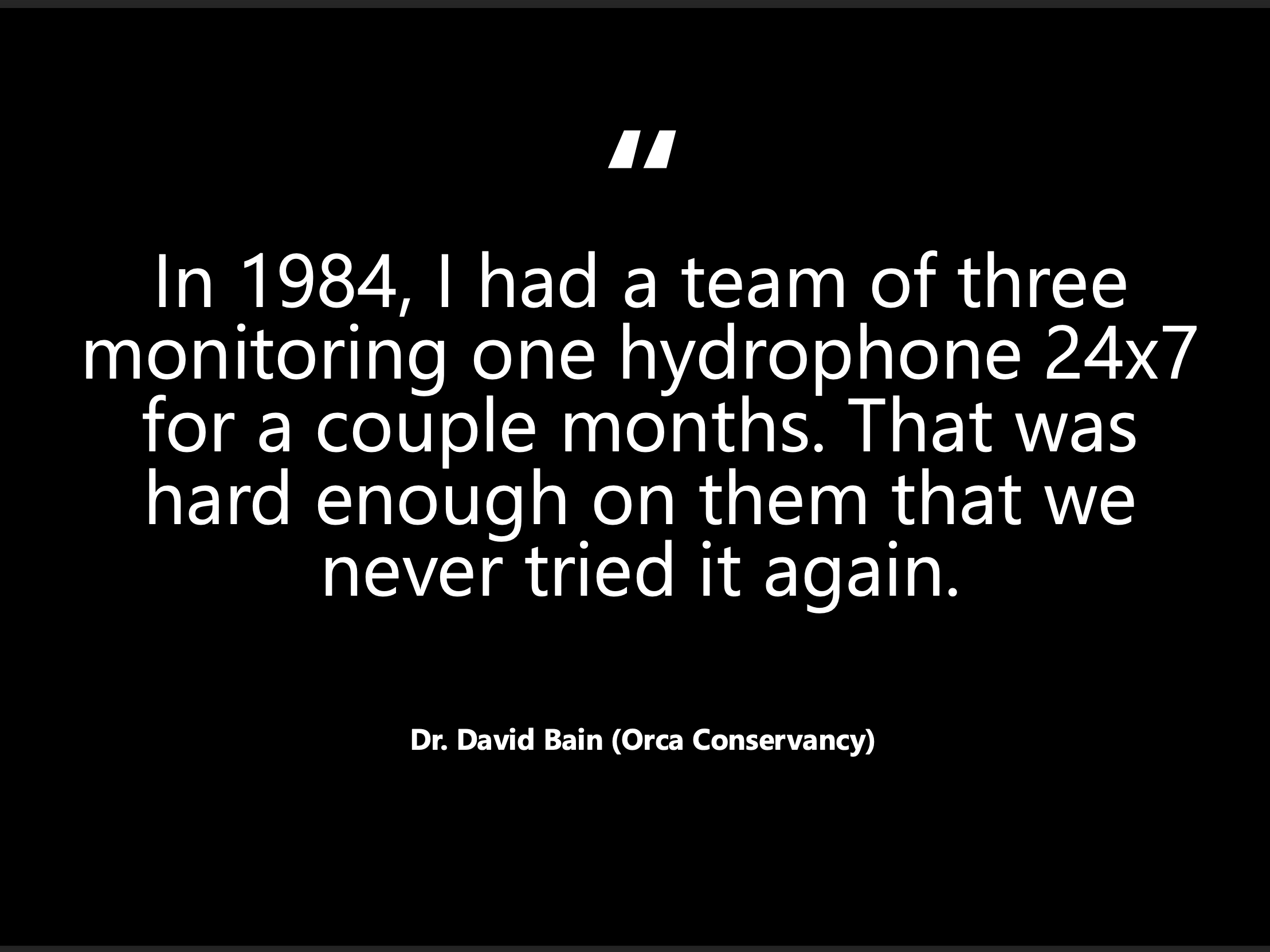
OrcaHello began at the 2019 Microsoft Hackathon when volunteers – including project leads Prakruti Gogia, Akash Mahajan and Chris Hanke – reached out to Orcasound eager to apply their skills to conservation close to home. The team partnered with oceanographer Dr. Scott Veirs (co-founder, Orcasound) and killer whale biologist Dr. David Bain (chief scientist, Orca Conservancy).
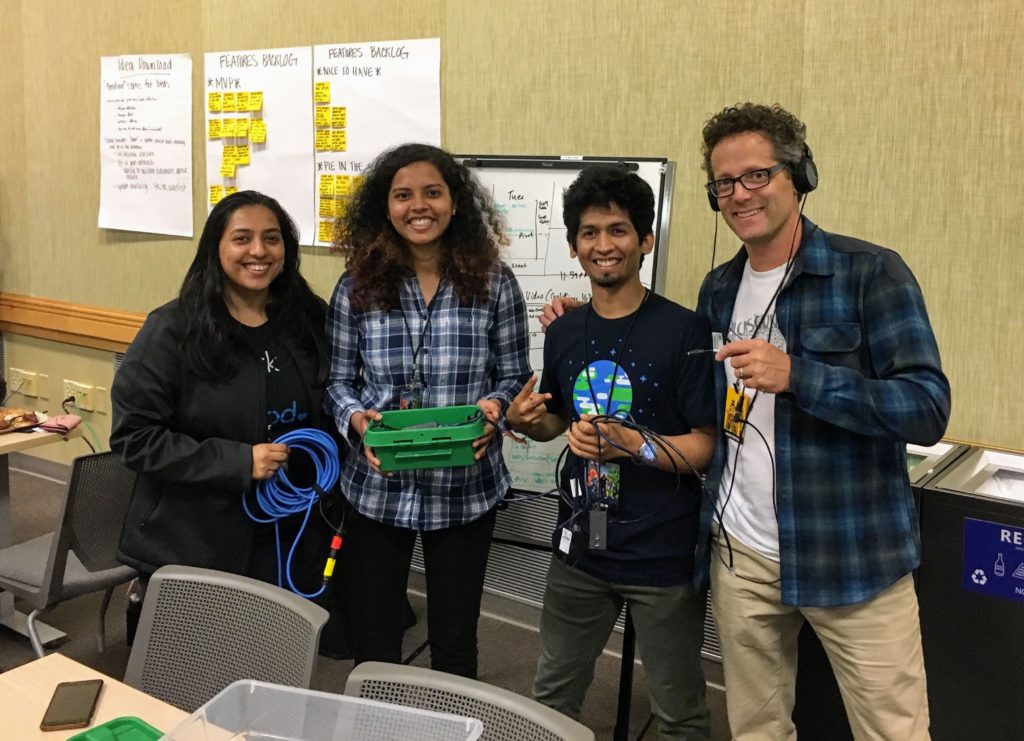

Supported by an AI for Earth Innovation Grant, a team of engineers, designers, and program managers collaborated remotely through pandemic-era virtual hackathons to launch the first live system in September 2020. Today OrcaHello is part of the Orcasound open source project, with new contributors joining every year.
In the Press
- (2026, April) Mongabay News: AI tool listens for endangered orcas in real time to reduce human disturbance
- (2025, Sept) Maple Ridge News: B.C. orcas welcome new calf, microphone captures newborn’s ‘first words’
- (2021, Nov) Ampere: Diving in data: How AI could help save the whales
- (2021, Oct) Root & STEM Podcast: How AI can save the whales
- (2020, Nov) KIRO 7 News: Protecting orcas starts with listening underwater
More information
For project background and a complete list of contributors see here.
Links and resources
- Github – Orcasound (org), and OrcaHello
- Listen live to Orcasound hydrophones
- Follow along on Bluesky
Talks
- ML “in the wild”: Invited talk at MERIDIAN Bioacoustics Seminar (Dec 2020), Dalhousie University, Canada – by Prakruti Gogia, Akash Mahajan, and Aayush Agrawal. Youtube
- ICASSP 2022 (accepted): Show & Tell demo track – link
Partners and support
- Orcasound — Cooperative hydrophone network providing live audio infrastructure and expert moderation (Dr. Scott Veirs)
- Orca Conservancy — Conservation partner and expert moderation (Dr. David Bain)
- AI for Earth Innovation Grant — Initial development funding (Microsoft, Leonardo DiCaprio Foundation)
- Quiet Sound & Washington Department of Fish and Wildlife (WDFW) — Grants for hydrophone network expansion
- Watkins Marine Mammal Sound Database (WHOI) — Recordings used to bootstrap Pod.Cast effort